Origin of the Image and Historical Context#

The print Noël (1902) was created in 1902 by the French artist George Auriol (1863–1938). It is a small-format color lithograph (about 18 x 12 cm), typical of Belle Époque greeting cards. At that time, sending illustrated cards for the end-of-year holidays was a true social ritual, rooted in bourgeois and artistic customs. In France, New Year’s cards were traditionally favored—people exchanged wishes for the coming year rather than strictly Christmas cards. Auriol participated in this culture by creating his own greeting print each year, intended for his friends and correspondents. Between 1898 and 1938, almost every year saw a new lithographed composition from his hand, distributed as an artistic postcard. These images—produced in small quantities and often printed on fine paper—combined the art of printmaking with the epistolary custom of sending wishes.
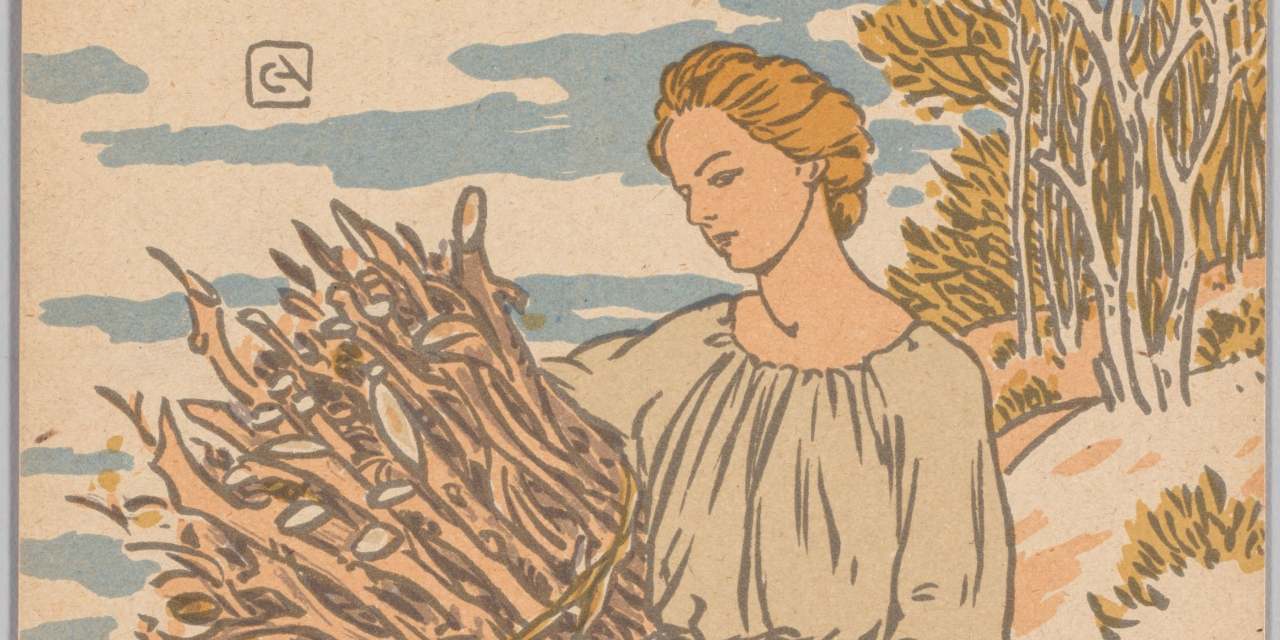
The Noël 1902 card is part of this series. It would have been sent during the 1902 holiday season to convey best wishes for 1903. It shows a young peasant girl returning from the woods, a bundle on her shoulder and a basket in hand, walking through a stylized winter landscape. Auriol includes a printed verse in the image, poetically expressing the transition from one year to the next. It reads: “Our regrets to nineteen hundred and two. For nineteen hundred and three, all our wishes – Mr. and Mrs. George Auriol,” followed by “Noël 1902” at the bottom of the page. With these words, the author symbolically bids farewell to the past year and sends his best wishes for the new one. This combination of image and poetry perfectly illustrates the context of the time: the greeting card was not just a decorative illustration, but a lucky charm, a messenger of friendly or family feelings, imbued with a touch of art and literature. At the turn of the 20th century, the rise of chromolithography enabled the mass distribution of color images, popularizing illustrated cards and artistic prints. Magazines such as L’Estampe et l’Affiche or Cocorico highlighted this flourishing of printed art. Auriol’s Noël 1902 fits into this visual effervescence: it reflects the meeting of the New Year’s greeting tradition with the Art Nouveau aesthetic then in vogue in Paris.
George Auriol, Illustrator, Typographer, and Poet of Art Nouveau#
George Auriol, whose real name was Jean-Georges Huyot, is a fascinating figure of the Belle Époque art scene. He was at once a poet, songwriter, graphic artist, illustrator, typographer, and painter—a multi-talented creator, emblematic of the multifaceted spirit of his era. Born in 1863 and having moved to Paris in the 1880s, Auriol frequented the vibrant Montmartre scene. He began at the famous cabaret Le Chat Noir, where he mingled with avant-garde artists and writers (Henri de Toulouse-Lautrec, Théophile Steinlen, Henri Rivière, Alphonse Allais…) and wrote songs and poems himself. His lively and imaginative personality earned him the mischievous nickname “Monseigneur l’évêque des campanules” (“His Lordship the Bishop of Bluebells”) from his friend Jules Jouy, in reference to his fondness for stylized floral motifs.
Auriol contributed as an illustrator to art and literary magazines (Le Chat Noir, L’Estampe et l’Affiche, Cocorico…), creating illustrated headers, cartouches, and graphic ornaments that closely intertwined text and image. Around 1901, he passionately embraced typography and designed several Art Nouveau-inspired typefaces. His most famous font, named Auriol, is characterized by supple, plant-like lines; it even influenced designer Hector Guimard, who drew inspiration from it for the iconic lettering of Paris metro stations. For the Georges Peignot foundry, Auriol designed innovative typefaces (Française-légère, Auriol-champlevé, Robur, etc.), bringing a modern and elegant touch to books and print.
At the same time, George Auriol continued his work as an illustrator and poster artist in the Art Nouveau style: he created posters, theater programs, illustrated menus, and book covers where his ornamental talent—full of flowers, arabesques, and naturalistic motifs—was on display. His graphic work, with its fine arabesques and harmonious compositions, breathes the optimism and creativity of the Belle Époque. Auriol was also a teacher (drawing professor at the École Estienne from 1924) and remained active until the 1930s. He died in 1938, leaving behind the image of an artisan-poet of Art Nouveau, who left his mark on both the history of typography and decorative arts. Even today, his name evokes a certain idea of 1900s graphic elegance, full of fantasy, poetry, and formal invention.
An Image with Cultural and Poetic Resonance#
Noël 1902 is part of a unique set of greeting cards created by Auriol and his wife throughout their lives. These printed images were not only used to convey the couple’s annual wishes, but also reflected the aesthetic and sometimes historical concerns of their time. For nearly forty years, from the late 19th century to the 1930s, the Auriols sent these illustrated cards as one would offer a miniature artistic gift to loved ones. Each card bore the year to come and an evocative scene: some celebrated nature, childhood, or the seasons; others—during wartime—expressed hope for peace or resilience (for example, the 1916 card shows a child perched in a tree above shells, symbolizing innocence preserved amid conflict). This family ritual became a true visual chronicle of the passing years, seen through the eyes of an artist.
In the case of Noël 1902, the image of a young woman returning from the woods, arms full of logs, carries a strong symbolic dimension. The bundle of wood she carries is meant to feed the fireplace—an ancestral symbol of the warmth of home in winter. Auriol thus implicitly evokes the light and human warmth that triumph over cold and darkness during the Christmas period. The basket in her other hand seems filled with fruit or light provisions, recalling nature’s gifts even in the cold season. The scene exudes an atmosphere of rural simplicity and tranquility, reassuring values associated with the end-of-year holidays. Through its refined style, soft tones, and sinuous lines typical of Art Nouveau, the image gives everyday life a poetic dimension.
On the left of the composition, a few printed verses—written by Auriol himself—give a voice to the image. By presenting “our regrets to 1902” and “all our wishes for 1903,” the artist-poet makes his work a bridge between past and future, a benevolent rite of passage to the new year. This alliance of calligraphic text and drawing forms a harmonious whole, in the spirit of the “beautiful cards” of the time, where as much care was given to the content as to the container. Noël 1902 thus goes beyond a simple decorative role: it is a work of art in its own right, but also a witness to popular practices (exchanging illustrated wishes) and the collective sensibilities of a bygone era. Today, rediscovering this image is to feel the spirit of a time when art was intimately woven into daily life, celebrating hope, nature, and affection through small poetic objects full of meaning. Continuing this tradition, the brand Ondes du Temps draws inspiration from such works to bring a bit of that visual and sentimental magic of yesteryear back into our present.
